
Table of Contents
Serverless computing is a cloud native modern computing technology. The term is a bit not in line with its name, here servers do exist but they are managed by cloud providers instead of business users and developers. It has many alternative names such as Serverless architecture, event based programming or we do at times call it function-as-a-service (FaaS) and we pay only for what we use. Serverless architecture ensures auto scaling which allows workload balance events during high peaks.
In traditional architecture, software developers are always concerned about infrastructure issues and server maintenance which impact their application availability, performance and administrative overhead involved in upkeep of infrastructure supporting the application. Serverless computing terminology redefines the way applications are supported and managed in modern day infrastructure without being worrying about underlying infrastructure and only focus on writing robust code.
In today’s article we will understand about Serverless computing, understand its architecture and its future in the arena of cloud development.
What is Serverless Computing
Serverless architecture is expected to grow to 90 billion worldwide and is expected to grow by 25% by 2032.
Serverless computing free developers from managing the infrastructure instead of focusing on writing and managing the code but less control over infrastructure. It is a cloud-native architecture where infrastructure management is left with external cloud providers and developers focus on code writing and management. Enterprises rely on Cloud providers – Azure, AWS, Google take care of provisioning, scaling and server management in Serverless computing architecture. The underlying physical servers, networking is cloud provider responsibility.
The Serverless model has two major aspects –
Function-as-a-service (FaaS) – are small, stateless units of codes which are executed in response to events such as AWS Lambda and Azure functions.
Backend-as-a-service (BaaS) – Fully managed backend services such as Storage, API, Dynamodb.
Serverless Computing Architecture
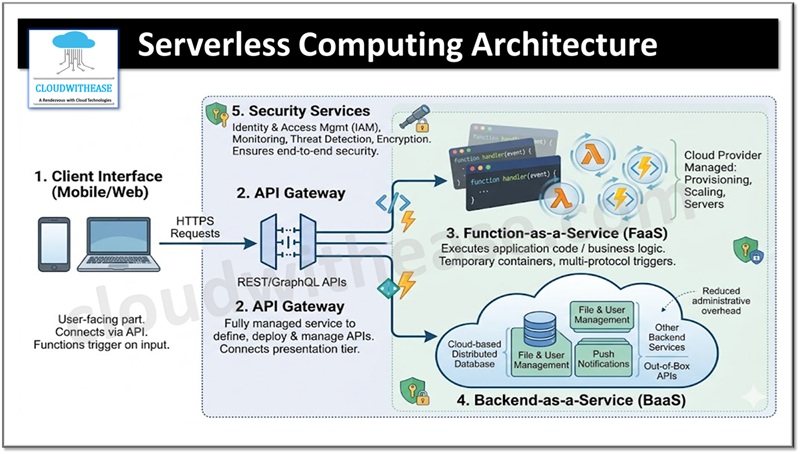
Serverless architecture has dependency on function-as-a-service (FaaS) and Backup-as-a-service (BaaS) where application code runs in temporary containers. Let’s look at Serverless computing architecture components.
API Gateway
It is a fully managed service to define, deploy and manage APIs. Developers use standard HTTPS requests to connect their presentation tier with functions written on Serverless platform for API integrations.
Function-as-a-Service (FaaS)
This layer executes application code / business logic with multiple protocol triggers. Function instances are deployed with compliance specific associated configurations.
Backend-as-a-Service (BaaS)
BaaS is a cloud computing model which functions as a cloud-based distributed database that reduces administrative overhead of management. BaaS includes cloud based storage, push notifications, server code, file and user management and other backend services which are having their own APIs (Out of box) for developers to integrate into their applications.
Client Interface
It is a user facing part of Serverless computing application. Client interface is mobile or web based. The client interface connects with the user interface Serverless backend using an API. The backend functions trigger on the basis of user input.
Security Services
Serverless application security provides an additional layer to handle access and identity management, monitoring, threat detection and encryption. The ultimate goal of this layer is to ensure backend functions, API and data storage security.
Benefits of Serverless Computing
- Burden on Developers and DevOps teams is significantly reduced as overhead of managing underlying infrastructure goes to cloud service providers.
- It is a cost effective model as you pay only for allocated resource based on function execution time and usage of resource
- With spikes in traffic to application infrastructure auto scales up and down without any additional configuration requirements
- Reactive systems as it is designed to trigger response to events
- Help developers in building modular applications with the aid of small functions called micro services thus reducing time to market and speed up development cycle
- Hosting cloud provider provides automatic regional replication and recovery