
Table of Contents
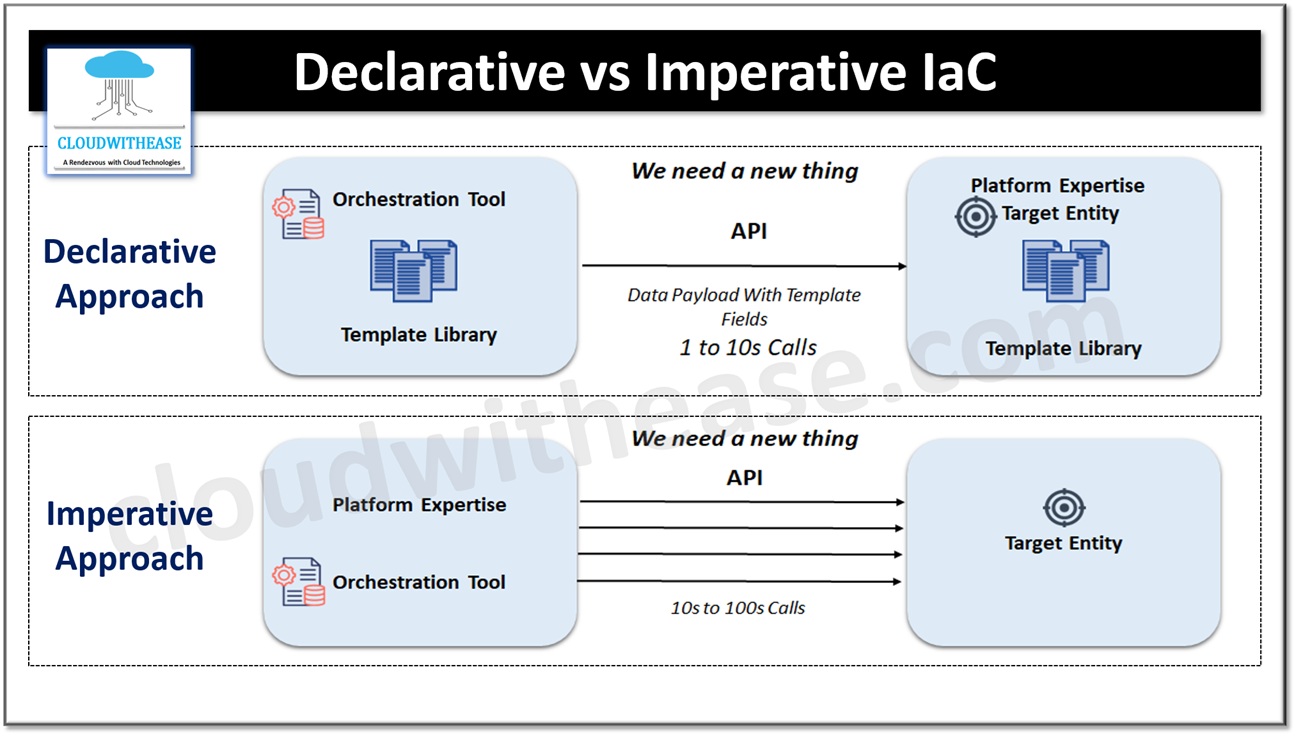
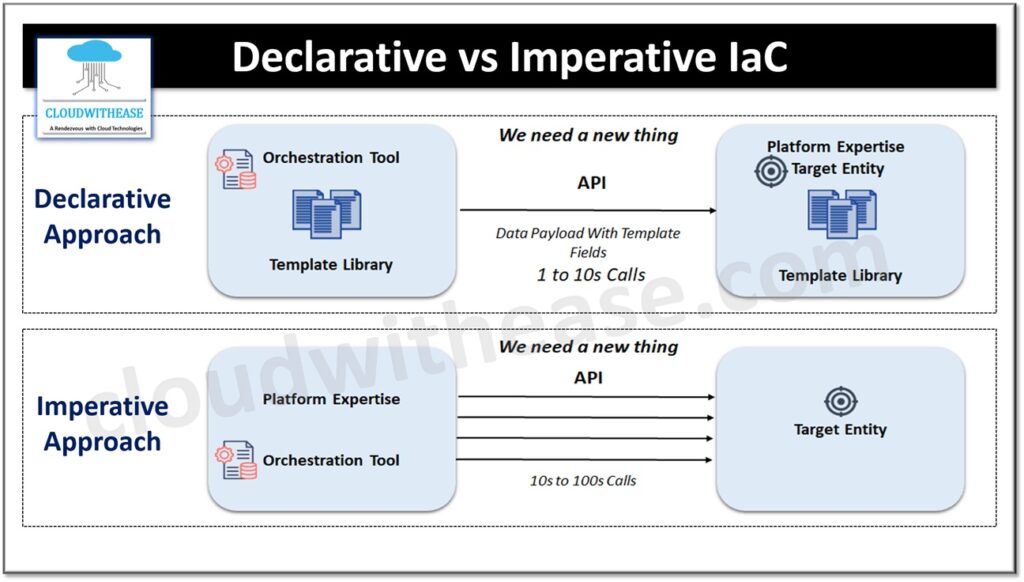
IaC approaches declarative and imperative works in slightly different manner. The declarative approach aims to define the desired state of the system, properties it should possess and resources required. Imperative approach defines specific commands which let you achieve the desired state of systems and infrastructure.
Deploying infrastructure on demand without any issues could be a big challenge for larger enterprises. As the digital IT landscape grows, deployment vows multifold. Infrastructure as a code (IaC) deals in managing deployment or provisioning of infrastructure using a code instead of manual.
With IaC configuration files are created with specific infrastructure related settings which makes it easier to edit and distribute configurations uniformly across systems. It ensures provisioning is uniform and the same every time. By documenting and coding configuration specifics to infrastructure IaC helps in configuration management and reduction in Adhoc configurations.
In today’s article we will understand the difference between IaC declarative and imperative approaches, their key differences and how to use them.
What is Declarative IaC
A declarative approach defines what you want your infrastructure – define the outcome. For example, you need a virtual machine with x specification’s, x memory, x number of CPUs, HA database with geo redundancy and tools to figure out what system to design here. This is just like setting a destination on a map and route is chosen by the navigation or GPS system on its own. Some known IaC tools which use declarative approach are Terraform, Puppet, Ansible, CloudFormation and Salt.
What is Imperative IaC
In an imperative IaC approach every single step is written down which needs to be executed to have a desired outcome – system or infrastructure as you wanted it to build or change your environment. This approach is about more control on the overall IaC process and you are responsible to handle errors, sequencing and state tracking. Some known IaC tools which use imperative approach are chef. Both Ansible and Salt support an imperative approach to some extent.
However, most IaC tools available in the market are designed keeping in mind a declarative approach as it is easier to maintain and it is less prone to configuration issues. Also it is easily integrated with automation tools which are meant to identify any mismatches between current and desired state of infrastructure and fix them automatically.
Comparison: Declarative vs Imperative IaC
| Features | Declarative IaC | Imperative IaC |
|---|---|---|
| Coding skills | Requires little knowledge of coding skills | Require more coding skills as manually each step needs to be defined |
| Nature of deployment | Ideal for voluminous and repetitive setups | Ideal for small simple one off tasks |
| Configuration drifts | Reduction in configuration issues near to zero | Requires step by step carefully crafted approach to avoid configuration issues |
| Control | DevOps engineer has very little control over overall process | DevOps engineer has full control over overall process |
| Use cases | Predicable, repeatable infrastructure setups Simple and scalable infrastructure setups | Full control over infrastructure provisioning is required Complex and fine-grained control requirement |
| Features | Reduced scripting requirements | Ideal for small deployments |
| Maintenance | It is easy to maintain and can be automated using IaC tools | It is difficult to maintain |
| Human error | Human error risk is lower due to automated configurations states | Chances of human error are higher due to manual steps |
| Example code | Defining an EC2 instance Instance_type = t1.test | Aws ec2 run-instances Instance_type t1.test |
Download the comparison table: Declarative vs Imperative Iac
To Summarize
Declarative IaC describes the desired end state of infrastructure (what) and lets the tool determine the steps to achieve it, enabling idempotence and easier drift correction. Imperative IaC specifies exact commands or procedures (how) to perform changes, offering fine-grained control but more complexity and potential for non-idempotent outcomes.
Related FAQs
Which approach is more idempotent? Declarative or Imperative
Declarative is typically idempotent by design; imperative scripts often require careful handling to be idempotent.
Which is easier to maintain at scale?
Declarative is generally easier to maintain for large, evolving infrastructures due to state reconciliation and reduced procedural complexity.
Which offers more control? Declarative or Imperative
Imperative offers finer-grained procedural control of the exact actions and order.
Which approach reduces configuration drift?
Declarative tools better detect and correct drift automatically by reconciling actual state with desired state.
Examples of Declarative and Imperative tools?
Declarative tools: Terraform, CloudFormation, Kubernetes manifests, Pulumi (when used declaratively)
Imperative tools: Shell scripts, Ansible ad-hoc tasks (imperative mode), custom CLI sequences, procedural Pulumi/SDK code.
Can you mix both approaches?
Yes, many teams use declarative definitions for desired state and imperative scripts for complex procedural tasks or bootstrapping.