
Table of Contents
The last few years starting 2023 is a mayhem for organizations. The increasing pressure on enterprises to adopt and scale operations using AI is forcing organizations to rethink their cloud deployment strategies to balance performance, growth along with security and compliance.
As enterprises adopt AI at a fast pace and workloads are becoming complex and more and more distributed in nature – the focus is shifting from infrastructure setup as a tactical decision rather to AI workload placements as an element of AI architecture.
Whether to choose on premises setups or public clouds or use a mix of both Hybrid approaches is the question organization seeking to maximize the benefits of AI along with maintaining consistent security, governance and compliance controls around the entire lifecycle of AI systems.
In today’s article we will learn about hybrid cloud strategies in the context of AI, how hybrid cloud approaches led to cost effective AI deployments.
AI Workloads Requirements
AI workload requirements are very different from traditional workloads. The AI workloads require huge computing power, GPUs, resources, memory etc. There are needs of harmonization of data flows, training of AI models, fine tuning, inference and so on. Putting AI in a silo will not serve the purpose for which AI is introduced in the organization. The approach calls for common data planes, unified security protocols and mobility of containerized workloads. This approach let organizations have a unified infrastructure to optimize performance, security, latency, cost and compliance.
Unique demands of AI workloads
- AI workloads process a huge amount of data as they require ability to scale without the constraints of compute and storage
- AI processing requirements may vary as per data it handles thus AI workloads require flexibility infrastructure
- Specialized hardware is required to run AI workloads and process AI specific use cases
- At times AI workloads handle processing of sensitive data hence they are governed by privacy laws
- AI workloads processing involves consumption of data across regions and countries and abided by residency requirements
How Hybrid Cloud Strategies help in Managing AI Workloads
Lack of a proper approach could quickly lead to quick accumulation of technical debit, performance degradation, duplication of infrastructure and escalating costs.
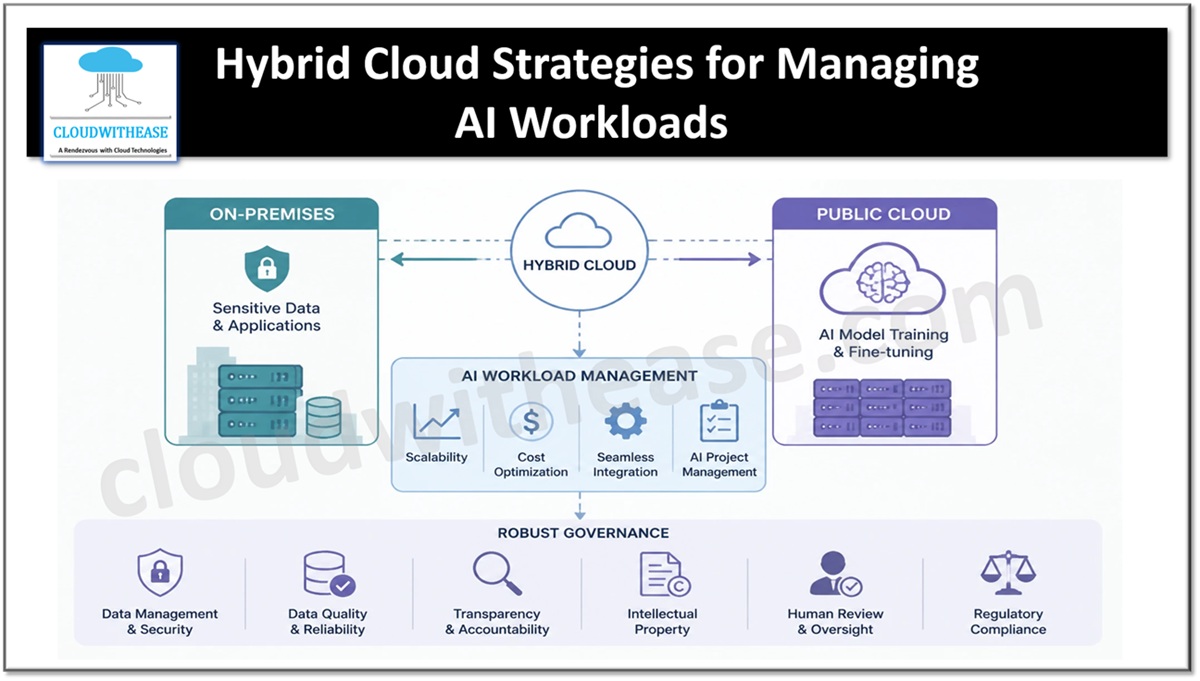
AI development often deals with organization sensitive data and compute intensive workloads. Having a hybrid cloud strategy helps organizations in keeping sensitive company data on premises under a secure environment and use public cloud for AI model training and fine-tuning. Hybrid cloud setups reduce the running costs by using public cloud resources to reduce operational costs as public clouds work on a pay-as-you-go subscription model.
The scalability of cloud services lets AI scale as per the need. The public clouds offer an economical approach towards AI development and AI deployments. A robust AI project management helps in overseeing the development and deployment of AI applications and ensure seamless integration between on premises and public clouds.
Robust governance around hybrid cloud setups is required for data management and security. It is mandatory to have robust governance in place to ensure high quality data output from AI systems which is reliable and consistent. Strong data governance brings transparency and accountability the way data is being handled, managed and governed. AI governance addresses concerns in the areas of intellectual property, input management, output transparency, human review of AI generated content to meet the regulatory requirements.
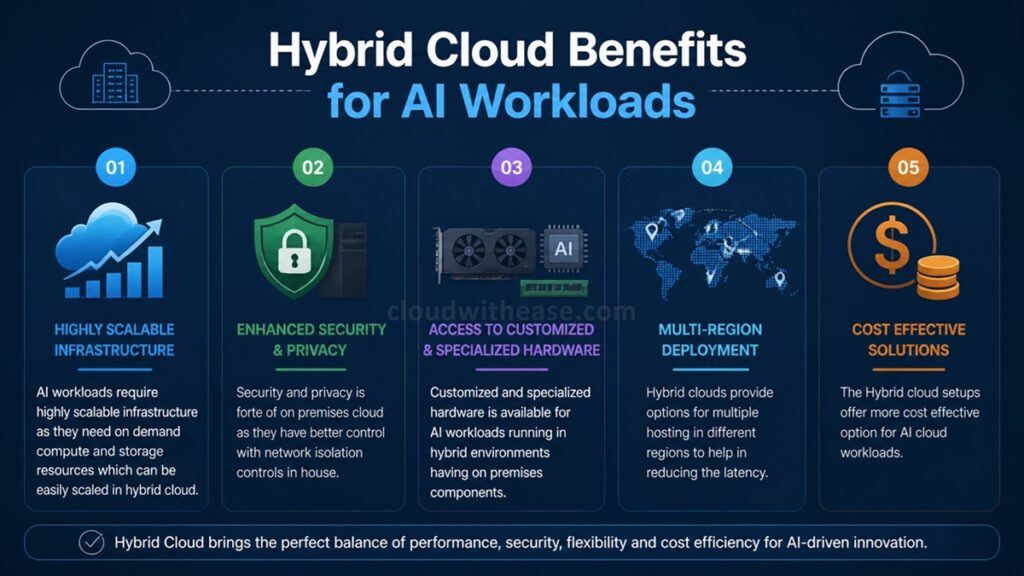
Hybrid Cloud Benefits for AI Workloads
- AI workloads require highly scalable infrastructure as they need on demand compute and storage resources which can be easily scaled in hybrid cloud
- Security and privacy is forte of on premises cloud as they have better control with network isolation controls in house
- Customized and specialized hardware is available for AI workloads running in hybrid environments having on premises components
- Hybrid clouds provide options for multiple hosting in different regions to help in reducing the latency.
- The Hybrid cloud setups offer more cost effective option for AI cloud workloads