
Table of Contents
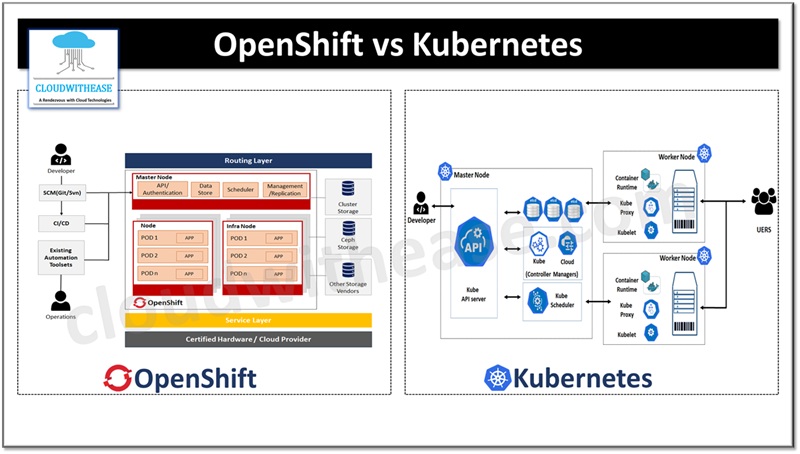
OpenShift is a Red Hat enterprise platform built on top of Kubernetes, adding developer tools, built-in CI/CD, stricter security policies, and a managed experience out of the box. While, Kubernetes is the open-source container orchestration engine underneath it all – more flexible and cloud-agnostic, but requires more manual setup and expertise to operationalize.
Containerization in cloud computing has revolutionized the way business applications are operated and managed. Gone are the days when deployment of a new business application meant a lot of work across cross functional teams by setting up new infrastructure to support applications, developers struggling to make their application working seamlessly on the underlying infrastructure.
Most popular container orchestration technologies – Kubernetes and OpenShift. Often called the K8 open-source framework to deploy and manage containers in an automated manner. It was originally developed by Google Inc. but later was donated to Cloud Native Computing Foundation (CNCF) way back in 2014.
OpenShift is a Redhat container platform and it is also open source like Kubernetes and has an enterprise version available.
In today’s article we will understand the difference between Kubernetes and OpenShift, their key characteristics, purpose, and operation.
Openshift
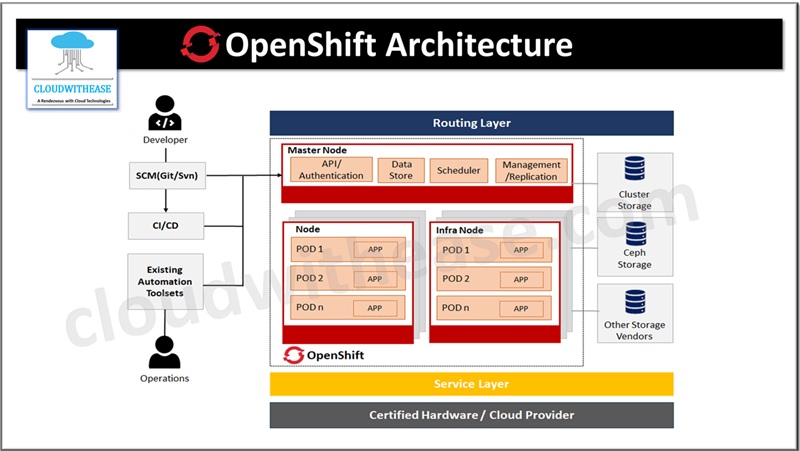
OpenShift is a platform as a service (PaaS) offering which lets you deploy and manage containerized applications. It has built-in tools to create images, storing images in an internal registry, OpenShift pipelines having support for cloud native CI/CD operations. It provides dedicated support and features having self-managed deployment models to build applications as per architecture requirements.
Characteristics of OpenShift
- Provides secure environment for container application development
- It has fine-grained controls and supports multi-tenancy
- It has service mesh capabilities, container scanning, multi-cloud support, built-in monitoring, and logging for applications
- Network traffic control plane is fully encrypted and supports FIPS 140-2 level 1 compliance
- Automated workflows with seamless integration to Jenkins
- Role based access control (RBAC) to prevent account compromise
- When OpenShift is used for application environment – Oauth and IAM are created by default
Kubernetes
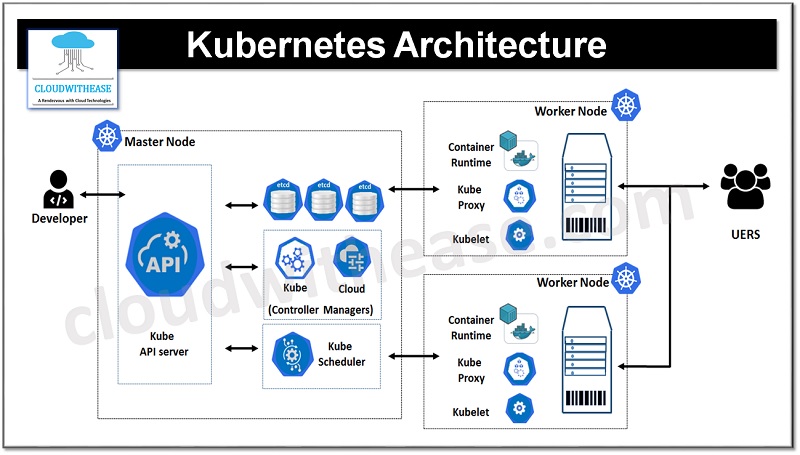
It is an open-source orchestration platform which helps in automating deployment, management, and auto-scaling of containers in the cloud ecosystem. Kubernetes is more like a Container as a Service (CaaS) platform and does not alone provide support for building the container image hosted on it. Additional tools and plugins are required to build container images. It can run on any type of infrastructure and Kublet is used to collect status of docker containers and data aggregation on control plane.
Characteristics of Kubernetes
- Ideal for migrating cloud-native and legacy applications
- Refactoring applications into microservices to align with business requirements
- Cloud or local can run on any infrastructure
- Has continuously repairs and self-healing capabilities
- Containers can be scheduled to scale and health management
- Balance workload across pods and resolving issues related to container proliferation
Comparison: OpenShift vs Kubernetes
| FEATURES | OPENSHIFT | KUBERNETES |
|---|---|---|
| Product | OpenShift is a Redhat Corporation product available as open source and in enterprise version. It offers paid support and subscription | Kubernetes is an open-source project self-support model originally developed by Google and donated to cloud native computing foundation (CNCF) in 2014 |
| Flexibility | It is less flexible compared to Kubernetes . Helm charts are not supported | It is independent of operating system and more flexible |
| Security | It is tough, certain level of permissions are mandatory to maintain security levels | It is easier to maintain security levels in Kubernetes |
| Deployment approach | Based on deployment config | Based on deployment objects |
| Management | It has Imagestreams which makes OpenShift better in image management | Management of container images is difficult |
| User experience | Has better support for its users | Additional tools are required to have better user experience |
| Networking | Native networking solution available for users | Third party plugins are required as some of the Kubernetes components do not have networking solution |
| Router vs ingress | External access for OpenShift services is done with router | Ingress objects allow external access for Kubernetes services |
| Integrated CI/CD | Jenkins integration makes deployment easier. | Jenkins can be integrated with Kubernetes with deployment in cluster |
Download the comparison table: OpenShift vs Kubernetes Comparison Table
Related FAQs
Q.1 Which one is easier to use? OpenShift or Kubernetes
OpenShift is more beginner-friendly for enterprises due to its guided UI and built-in tooling. On the other hand, Vanilla Kubernetes has a steeper ops curve but more flexibility.
Q.2 Is OpenShift free?
Kubernetes is fully open-source and free. OpenShift has a free community version (OKD), but the enterprise version (Red Hat OpenShift) is paid and includes support.
Q.3 Which one is more secure by default? OpenShift or Kubernetes
OpenShift, as it enforces stricter security out of the box (e.g., no root containers by default, built-in RBAC + SCCs). Kubernetes security requires manual hardening.
Q.4 Can I run Kubernetes workloads on OpenShift?
Yes. Since OpenShift is built on Kubernetes, standard Kubernetes manifests (YAML/Helm charts) work — though some may need minor tweaks for OpenShift’s security constraints.
Q.5 Which has better CI/CD support? OpenShift or Kubernetes
OpenShift has built-in CI/CD (OpenShift Pipelines via Tekton, OpenShift GitOps via ArgoCD). Kubernetes needs third-party tools like Jenkins, Argo, or Flux.
Q.6 Which should I choose for cloud deployments? OpenShift or Kubernetes
Kubernetes (via EKS, GKE, AKS) is ideal for multi-cloud/cloud-native teams. OpenShift suits enterprises needing consistency across on-prem + cloud with commercial support.
Q.7 Is OpenShift slower to update than Kubernetes?
Yes, OpenShift releases lag slightly behind upstream Kubernetes, as Red Hat stabilizes and certifies each version before release.
Q.8 What Is OKD?
OKD is the open-source, community-supported upstream of OpenShift. It is free to use but has no enterprise support.