
Table of Contents
Emerging cyber security threats have become more and more sophisticated over the past few years. With cloud computing, AI and ML burst open a plethora of opportunities for bad actors to utilize the opportunity and use technology to launch more sophisticated cyber attacks which no one would have even dreamt about a few years back.
Enterprises are on their hook when it comes to safeguarding their data and infrastructure from prying eyes of cyber criminals. Cloud security risks are surfacing much stronger as cloud adoption is extended beyond basic computing and storage. Enterprise business applications are hosted onto cloud such as Azure, AWS and Google which offer great scalability and performance but also expand the cyber threat landscape.
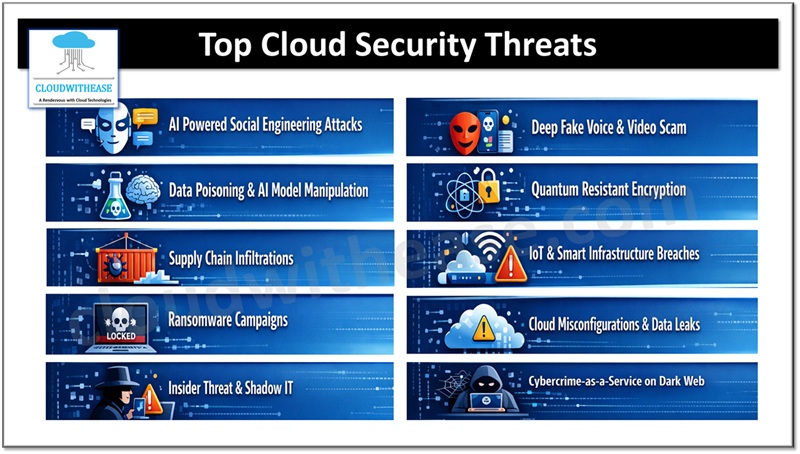
In today’s article we will understand top cloud security threats and mitigation strategies to address them.
List of Top Cloud Security Threats
AI Powered Sophisticated Social Engineering Attacks
As more and more organizations move towards adoption of AI in their businesses. Cyber attackers are using generative AI to build psychological profiles using social media platforms such as LinkedIn, Slack leaks, and customer support transcripts which are used to train small LLMs which can speak or behave like your team. When phishing mails are launched they adapt the tone and timing of the organization’s internal culture. Support bots are compromised with phishing attacks which remain active without being detected to gain trust and access to insider information.
Deep Fake Voice and Video Scam
Real-time deep fake calls are done using stolen meeting recordings and voice data. Real-time generative rendering and emotion machine models can simulate CEO voice on MS Team’s call and even can copy breathing patterns to be very precise. Full live video con chat leading to loss to small businesses as their business pages on social media accounts are hacked using cloned voices and spoofed profiles.
Data Poisoning and AI Model Manipulation
Data poisoning is done at an AI source where attackers inject tainted records into public data sets or in Supplier-fed pipelines. Poisoned data tweak inference behaviour and exploit AI model update APIs or injects adversarial samples to train models to throw incorrect output over a period of time.
Quantum Resistant Encryption
Quantum safe encryption initiative runs into rush mode creating week spots and resulting in applications and tools rolled out without proper testing of interoperability. Attackers are exploiting mismatched key exchange, introducing ambiguity in random number generators. The hybrid encryption layers existing between legacy systems and modern systems are the target of hackers. The exploitation is already started in the back-end with migration gaps.
Supply Chain Infiltrations
Modern day supply chain breaches occur in automation. Attackers are compromising the build systems or container registries having low visibility. Threat actors injecting malicious dependencies which bypass checksum validations as signing infrastructure is itself compromised. Hidden supply chain vulnerabilities are exploited and remain inside a payload until an upgrade or patch request comes up.
IoT Devices & Smart Infrastructure Breaches
The IoT devices become the weakest link in the security space. Attackers target IoT device management systems to gain access over all IoT devices and not just a few of them. Once MQTT broker or edge gateway is compromised unauthorized access is gained at command level for sensors. Attackers are chaining IoT exploits and moving from device level control to network level control to shut down sensors or feed in false telemetry, re-routing automations scripts.
Ransomware Campaigns
Steal information and data, threaten public leaks, hit backup systems to gain control and launch DDoS attacks. These campaigns can persist for weeks/ months without being detected.
Cloud Misconfigurations Leading to Breaches or Data Leaks
Misconfigurations in cloud ecosystems are like silent sand mines which can explode at any time. Cyber criminals are running automated bot crawls to instantly exploit any unsecured container or VM, exposed service account.
Insider Threat & Shadow IT
This risk is no longer contained to cloud resources but extended to AI assets as well. Usage of unapproved SaaS tools in internal environments usually go unnoticed to cyber security teams. Attackers exploit this as this becomes a weak entry point for them.
Cybercrime-as-a-service Expansion in Dark web
Cybercriminals are using pipelines which are sold as monthly subscriptions to launch phishing and cyber espionage attacks, ransomware builder tools, access brokers and laundering devices. Even corporate VPNs and cloud consoles with uptime guarantees are available. AI driven support tools support customers in handling ransom negotiations even.
Mitigation Strategies – Cyber Security Threats
- The transparency and being vocal about ransomware attacks can help to control the narrative cyber attackers are trying to establish. Sharing verified updates and outlining steps to combat it for your customers and investors who might be getting mixed stories help to contain the damage.
- Monitoring behavior patterns over a period of time can give hints of big attacks. Usually before a full breach small signs such as odd logins or unfamiliar device connection could indicate a bigger threat.
- Dark web tracking with an early alert window could help in gaining insight into a feed.
- Running phishing simulations act as the best compliance audit tool. Regular internal campaigns reveal how users will behave or act under real world scenarios.
- Systems need to be scanned continuously to identify any vulnerabilities, weak configurations and unpatched assets.
- Anomalous network behavior detection is something difficult to detect with manual inspection and can be easily achieved using AI Analytics which can detect patterns in anomalous network behavior by spotting irregularities in login-timings and multi-vector anomalies.
- Adapt zero trust security framework across all systems so as to trust no device, no user and no process by default