
Table of Contents
Cloud computing is incomplete without mentioning cloud databases. Major cloud players in the market provide data as a service, no SQL based databases which provide high availability and higher scalability. Microsoft and AWS are two major cloud providers in this space which offer Cosmos DB and AWS DynamoDB which are fully managed cloud based database services.
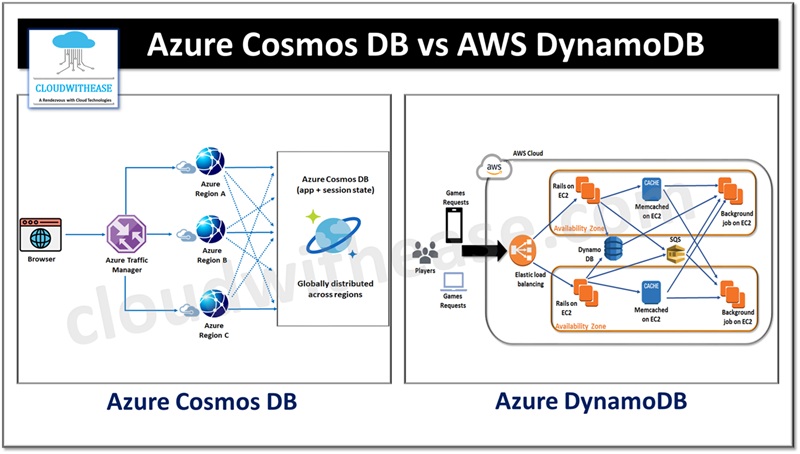
In today’s article we will understand the comparison between Azure Cosmos DB and AWS DynamoDB, their key features, commonality and differences.
What is Azure Cosmos DB
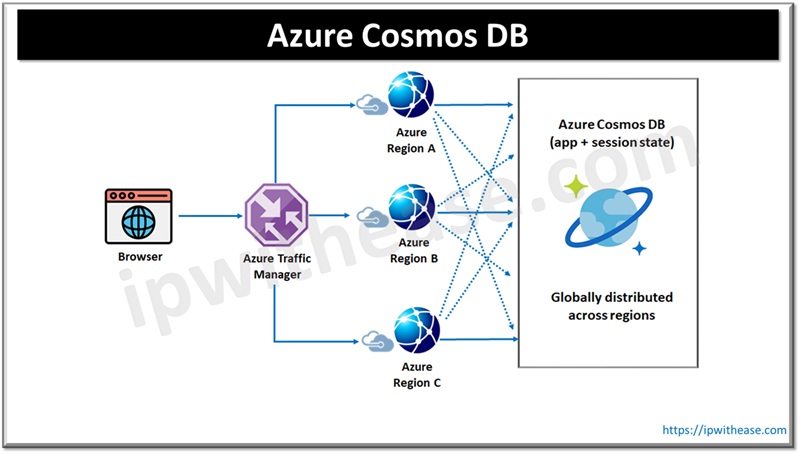
Azure Cosmos DB is a fully managed no SQL database which supports all SQL data models such as graphs, documents and APIs. It is a database which supports high availability and scalability. Since it is a managed database you need not to worry about its management- updates, patching etc. The Azure free plan includes the first 1000 RU/ with 25 GB space for storage.
Features of Azure Cosmos DB
- Ease of integration with multiple SDKs, open source APIs, Azure other services. Any language of your choice can be used such as .net , have, node.Is, python etc. API models supported are Sql, MongoDB, etc.
- High speed and real time database access with scalability and almost immediate elasticity
- Automatic updates and end to end database managed by Microsoft
- Azure Cosmos guarantees 99.999% availability.
- All data is encrypted and it ensures high security
What is AWS DynamoDB
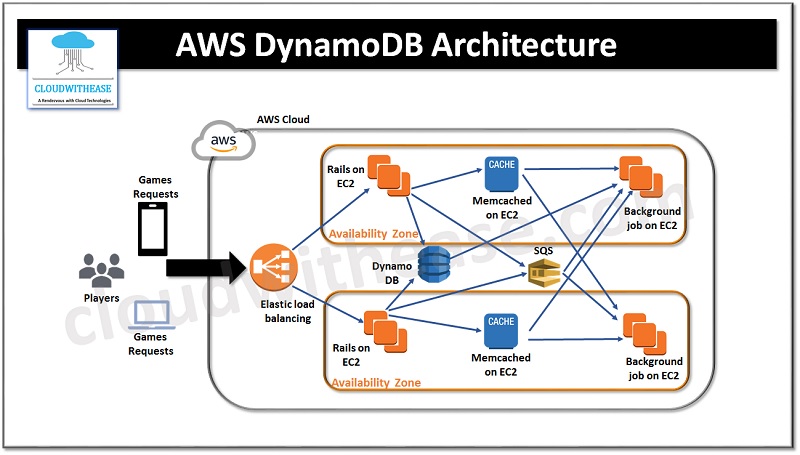
AWS DynamoDB is a highly scalable no SQL database. It is fully managed from updates, patching, backups and security perspective. It can handle trillions of requests every day and 20 million per second. It is ideal for applications that cannot afford latency such as IoT, gaming, web, Mobile etc.
In free offering AWS DynamoDB has 25GB of storage and 200 million read and write requests per / month.
Features of AWS DynamoDB
- Data encryption, automatic backups, auto restore with 99.999% availability committed
- Easier integration with other AWS services
- High throughput and low latency irrespective of scalability requirements
- Server-less service from AWS
Azure Cosmos DB vs AWS DynamoDB
| Features | Azure Cosmos DB | AWS DynamoDB |
|---|---|---|
| Migration Support | Support for JSON, MongoDB, SQL and csv files | Support for SQL, API, MongoDB, Cassandra, table API and Gremlin. |
| Scalability | Has a request unit to connect with database Having both read / write to scale unit | Read and write unit is not one but separate for independent scaling based on requirement |
| Partitioning | Storage and query large amounts of database grouped into partitions | Storage and query on large amounts of data but also an optional sort key to sort data in specific partition if need be Global secondary index is a secondary partition key |
| Query Flexibility | Support multiple databases and real Tim feeds hence query capabilities are more flexible It does not support mobile clients on its own and requires backend support | Limited query capabilities use AWS amplify data store so there is no need for a back end to support mobile clients |
| Trigger Mechanism | Cosmos DB uses change feed to process data Using containers Change feed is by default enabled | DynamoDB uses streams to process data wherein event information is recorded and fed into stream Streams need to be enabled first for capturing events |
| Multiple Regions | No such feature in Cosmos DB | Uses global tables which are used to replicate data in multiple regions together. |
| JSON Structure | Simple JSON structure | JSON structure is complex |
| Features | * Document maximum size is 2MB * Support for transaction within one partition * Provisioning modes – provisioned, server-less and auto scale * API supported – SQL, MongoDB, PostgreSQL | * Item size maximum is 400 kb * Supports transactions across tables and multiple Partitions * Available modes are – provisioned, on demand and auto scaling * API support – PartiQL and DynamoDB |
| Use Cases | * Claims processing * Real-time payment and transactions * IoT telemetry * SaaS applications | * Powering web and mobile back ends * E-commerce and retail * Media verticals * Education * Gaming applications |
Download the comparison table: azure cosmos db vs aws dynamodb