
Table of Contents
AI-driven threat detection in cloud infrastructure is the use of artificial intelligence to automatically identify, analyze, and respond to security threats across cloud environments in real time.
Cloud computing became very popular in the past couple of years with its flexibility, scalability and made way for cost efficiency in organization boardrooms but at the same time with all its benefits it gave rise to increase in complexity and scale of cyber threats.
Traditional security techniques failed to prevent or detect zero day attacks and anomalous behavior which could not be predicted. Recently cyber security posture is enhanced with use of artificial intelligence (AI), Machine learning (ML) and anomaly detection.
AI enabled security systems understand threats and identify anomalies and help in prevention of cyber threats.
In this article we will learn more in detail about AI-Driven Threat Detection in cloud infrastructure, how it works and its key characteristics.
Threat Detection in Cloud
Cloud services host critical services and sensitive data on cloud which is targeted by cybercriminals using advanced techniques such as ransomware, phishing, data exfiltration, and DDoS attacks. As a result, we need to bear financial losses, reputational damage and loss to business.
Signature based malware programs, rule based firewalls and intrusion detection / prevention systems are traditional security systems and they fail to recognize advanced polymorphic cyber texts and most of the time SOC team is bogged down by huge number of false+ve alerts leading to fatigue. Manual updates to security databases and heuristic-based detection of threats cannot handle the present day persistent threat landscape.
AI-Driven Threat Detection
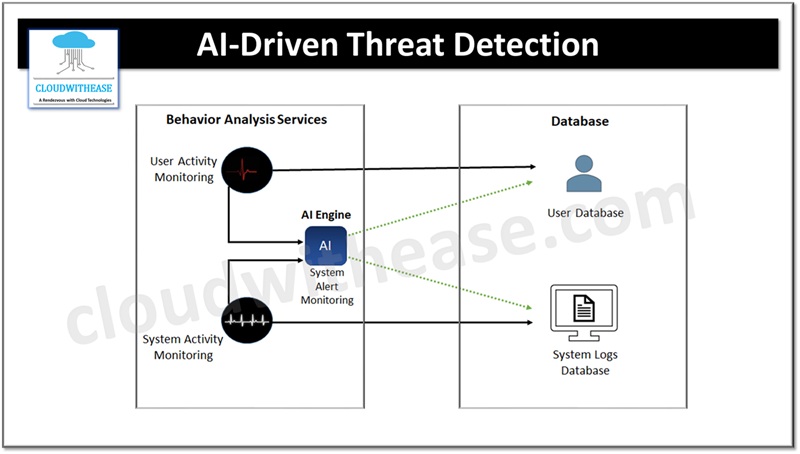
The traditional security systems are replaced by intelligent, automated threat detection, mitigation and response systems which are AI based. Advancement in the cyber security domain is achieved using AI and ML, deep learning, anomaly detection. AI security frameworks are constantly learning from data sets and understanding emerging risk patterns and growing persistent threats.
The behavioral analysis of AI systems help in establishing a baseline for normal user behavior to abnormal activity to detect malicious intent. For example, an AI system can detect unauthorized attempts of access, lateral movement in the network and data exfiltration tries. AI based systems reduce the false+ve alerts and improve threat identification accuracy much more compared to their traditional counterparts.
AI driven security tools execute the threat response and auto response thus minimizing need for manual intervention and improved mitigation times. Examples of some such actions are isolation of compromised endpoints, blocking malicious IP addresses etc.
AI based solutions do have a flip side as well. Model training requires large database access which could be a cause of concern due to privacy and other regulatory requirements. AI models are also prone to adversarial attacks wherein hackers can feed input data to model.
AI-Driven Threat Mitigation
Security solutions using AI can detect threats in real-time using ML algorithms and superior anomaly detection methods. They learn new attack patterns and are more effective in identifying unknown threats.
Various machine learning models are used by AI security solutions – supervised learning models use labelled datasets to recognize and train on malicious behavior, unsupervised learning models exploit networks and identify anomalies. Behavioral analysis improves threat detection capabilities by analyzing user activities to detect internal threat or compromised credentials.
Difference: Traditional Security Systems and AI based Security Systems
| Features | Traditional Security Systems | AI based Security Systems |
|---|---|---|
| Threat detection | Rule and signatures | Behavior and anomaly based |
| Adaptability | Limited | Highly adaptable |
| False+ves | Very high | Lower with properly training AI model |
| Zero day attacks | Delayed or manual detections | Real-time detections |
| Response times | Delayed or manual | Automated response |
| Scalability | Predefined rules and scalability is limited | Can scale up with big data processing |
Conclusion
AI based threat detections are all about advanced capabilities to detect, stop and eliminate cyber threats in the cloud landscape. ML algorithms, anomaly detection and behavior analysis is elevated to the next level and lowers the number of false+ve alerts. AI will aid in continuously improving the resilience in cloud security without any doubts however, its appropriate usage considering adversarial attacks, computational outcome issues need to be addressed.